



- Joined
- Apr 17, 2018
- Messages
- 26,134
One of my favorite things on affLIFT is when members decide to build in public.
Not because every campaign turns green right away. They don't. But because follow alongs are where the real learning happens.
You launch something.
You share what you are doing.
You get feedback.
You make adjustments.
You keep going.
That process is extremely valuable, both for you and for everyone else reading your thread.
I went back and looked at some of the most popular follow alongs we've had on affLIFT. Threads like @bishal's Journey To $100/Day with PPV, @Anth's Revcontent VSL follow along, @BobZhang's 30-day challenge, @Desha's Facebook/Zeydoo breakdowns, @Varun's RevContent + Nutra thread, @Amixo's Zeydoo + Facebook Ads thread, and a bunch of others.
Some of those threads have tens of thousands of views and hundreds of replies.
The cool part?
They all have a lot of the same ingredients.
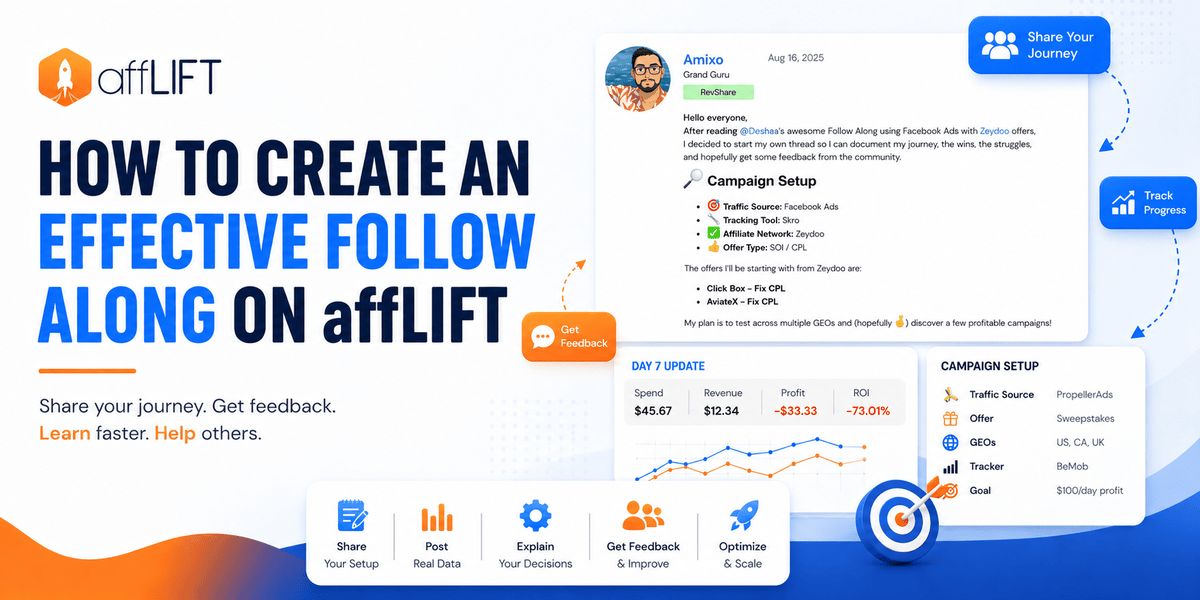
So, if you are thinking about starting your own follow along, here is how to make it useful, interesting, and worth following
This is probably the biggest one.
A lot of members wait too long to start their follow along because they think they need to already have a profitable campaign, a perfect setup, or some huge result to share.
You don't.
Some of the best follow alongs on affLIFT started with something as simple as:
The point of a follow along is not to pretend you have everything figured out. The point is to document the journey.
If you wait until you have a perfect campaign, you miss the most valuable part of the story.
The best follow alongs make it easy for everyone to understand what is being tested.
At the top of your thread, include the basics:
For example, @Anth opened with Revcontent + Voluum + MaxWeb + VSL + $80 payout.
@Desha opened with Facebook Ads + BeMob + Zeydoo + SOI/CPL + specific GEOs.
@BobZhang opened with PropellerAds + Voluum/Binom + Zeydoo/Mobidea + a very clear $3,000 profit challenge.
That context matters.
Without it, people have to guess what you are doing. When people have to guess, they are less likely to help.
A good follow along needs a direction.
It does not have to be crazy. It just needs to be clear.
Some examples:
@bishal's thread worked so well because the goal was simple: get to $100/day with PPV. Then he shared the losses, the optimizations, the first green day, and eventually much bigger numbers.
@markbeats had a simple goal too: spot 3 profitable campaigns. It made the thread easy to follow and easy for people to jump in and help.
Your goal does not need to be huge.
Honestly, "I want to stop losing money and understand what I'm doing wrong" can be a great goal if you are willing to share the data.
This is where the magic happens.
The best follow alongs do not just say:
"Campaign is doing good."
They say:
That is useful.
You do not need to reveal your exact offer, your exact landing page, or every little detail that could get your campaign ripped. But you should share enough data for people to understand what is happening.
Useful numbers to post:
A lot of the top follow alongs had tons of screenshots. @Amixo's Facebook/Zeydoo thread had more than 150 attachments. @BobZhang's challenge had more than 180. @L1Ght's arbitrage thread had more than 160.
Screenshots make the thread easier to follow and more trustworthy.
Again, blur anything sensitive. Protect your campaign. But show enough that people can actually learn from it.
A follow along becomes really valuable when you explain your thinking.
Do not just post the result.
Post the decision.
For example:
@Varun's RevContent follow along is a great example. He did not just post big revenue screenshots. He explained the pain of building a blacklist, testing placements, finding converting widgets, dealing with bid changes, and building an asset over time.
@Anth's Revcontent VSL thread was similar. He shared the ugly part too. At one point he was down more than $11,000 before turning the campaign profitable overall.
That is powerful because it shows the actual process.
This is important.
If you only post when things are green, your follow along becomes less useful.
The red days are where people can help you.
Post when:
Some of the most popular follow alongs on affLIFT were not straight-line wins. They had failed tests, pivots, broken tracking, low quality traffic, offer problems, domain flags, moderation issues, and a lot of "what should I do next?" moments.
That is normal.
Affiliate marketing is messy. A good follow along shows the mess.
If you want good feedback, ask good questions.
Bad question:
"Any advice?"
Better question:
"This campaign has spent 3x payout with no conversions on these zones. Would you pause the zones now or wait for more data?"
Bad question:
"Why am I losing money?"
Better question:
"My CTR is decent but my LP CTR is terrible. Would you test a new angle, a shorter lander, or direct link this offer?"
The more specific your question, the better the replies will be.
This is one of the reasons @markbeats' thread became so useful. He shared what he tested, what confused him, and where he needed help. That gave members something to respond to. I even ended up running a version of his campaign setup and sharing my own thought process in the thread.
That is exactly what makes affLIFT awesome.
You do not need to update every hour.
But you should update consistently enough that people can follow the story.
A simple update format works great:
You can post daily if you are actively testing. You can post every few days if things are moving slower. If a campaign turns into a long-term project, milestone updates are fine too.
@BobZhang's thread is a great example of consistency. He kept pushing toward his $3,000 challenge, failed over and over, and eventually completed it on the 22nd attempt.
That is the kind of thread people remember.
Not because everything was perfect.
Because he kept going.
Your first post should be clean enough that someone can understand it quickly.
Here is a simple template you can use:
That kind of first post makes it easy for members to help you.
I completely understand not wanting to reveal everything.
You should protect:
Instead of posting the exact offer, say:
"Low payout SOI survey offer in Tier 2 GEO."
Instead of posting the exact lander, say:
"Simple 2-step quiz lander with a strong CTA."
Instead of posting exact zone IDs, say:
"I moved the top converting zones into a whitelist campaign."
That gives value without handing someone the keys to copy your campaign.
This might be the most underrated benefit.
When you post a follow along, you are more likely to keep going.
You know people are watching.
You know people are waiting for the next update.
You know you are going to have to explain what happened.
That accountability matters.
@BobZhang said it well in his own way: updating the follow along made him learn, think, and do more.
That is exactly the point.
Even if nobody replies right away, the act of writing your update forces you to think through your campaign.
What happened?
Why did it happen?
What should I do next?
That alone can make you a better affiliate.
When you hit a milestone, post it.
First conversion? Post it.
First green day? Post it.
First $10 profit? Post it.
First $100/day? Definitely post it.
First time you recover from a big loss? Post it.
Those moments motivate other members.
@bishal's journey is still inspiring because you can see the progression from losing money to hitting $100/day and then much bigger profit.
@Anth's thread is inspiring because he showed the recovery from a painful loss to a profitable native campaign.
@Amixo's thread is exciting because you can watch the milestones stack up: $100/day profit, $300/day profit, $500+ revenue, then $1,000+ revenue days.
Those updates are fun to follow.
They also prove that the work can pay off.
If you want the short version, here it is:
You do not need to be an expert.
You do not need a huge budget.
You do not need to have everything figured out.
You just need to take action and be willing to document the process.
The members who do that tend to learn faster because they get feedback from people who have already been through the same problems.
That is why follow alongs are such a big part of affLIFT.
They help the person posting.
They help the members replying.
They help the quiet readers who are dealing with the exact same problem but have not posted yet.
So if you are testing something right now, start a follow along.
Post the plan.
Post the numbers.
Post the wins.
Post the mistakes.
Let us follow along with you.
Thanks,
Luke
P.S. If you start a new follow along after reading this, reply with a link to it so we can check it out!
Not because every campaign turns green right away. They don't. But because follow alongs are where the real learning happens.
You launch something.
You share what you are doing.
You get feedback.
You make adjustments.
You keep going.
That process is extremely valuable, both for you and for everyone else reading your thread.
I went back and looked at some of the most popular follow alongs we've had on affLIFT. Threads like @bishal's Journey To $100/Day with PPV, @Anth's Revcontent VSL follow along, @BobZhang's 30-day challenge, @Desha's Facebook/Zeydoo breakdowns, @Varun's RevContent + Nutra thread, @Amixo's Zeydoo + Facebook Ads thread, and a bunch of others.
Some of those threads have tens of thousands of views and hundreds of replies.
The cool part?
They all have a lot of the same ingredients.
So, if you are thinking about starting your own follow along, here is how to make it useful, interesting, and worth following
1. Start before everything is perfect
This is probably the biggest one.
A lot of members wait too long to start their follow along because they think they need to already have a profitable campaign, a perfect setup, or some huge result to share.
You don't.
Some of the best follow alongs on affLIFT started with something as simple as:
- "I'm testing this traffic source for the first time."
- "My goal is to get to $100/day profit."
- "I keep losing money, so I'm going to document the process and get feedback."
- "I'm trying to make this campaign green."
The point of a follow along is not to pretend you have everything figured out. The point is to document the journey.
If you wait until you have a perfect campaign, you miss the most valuable part of the story.
2. Give us the campaign snapshot right away
The best follow alongs make it easy for everyone to understand what is being tested.
At the top of your thread, include the basics:
- Traffic Source: PropellerAds, Revcontent, Facebook Ads, Zeropark, ExoClick, etc.
- Tracking Tool: BeMob, Voluum, Binom, Skro, Keitaro, etc.
- Affiliate Network: Zeydoo, Monetizer, MaxWeb, Golden Goose, PeerFly, Hooligapps, etc.
- Offer Type: sweepstakes, SOI/CPL, VSL, nutra, mVAS, casino, revshare, pin submit, etc.
- Payout: even an approximate payout is helpful
- GEOs: the countries you are testing
- Starting Budget: what you are comfortable spending to test
- Goal: what you are trying to accomplish
For example, @Anth opened with Revcontent + Voluum + MaxWeb + VSL + $80 payout.
@Desha opened with Facebook Ads + BeMob + Zeydoo + SOI/CPL + specific GEOs.
@BobZhang opened with PropellerAds + Voluum/Binom + Zeydoo/Mobidea + a very clear $3,000 profit challenge.
That context matters.
Without it, people have to guess what you are doing. When people have to guess, they are less likely to help.
3. Pick a clear goal
A good follow along needs a direction.
It does not have to be crazy. It just needs to be clear.
Some examples:
- Get my first green campaign
- Reach $20/day profit
- Reach $100/day profit
- Find 3 profitable campaigns
- Test 10 offers in 30 days
- Scale one profitable GEO
- Learn a new traffic source
- Build a whitelist campaign
@bishal's thread worked so well because the goal was simple: get to $100/day with PPV. Then he shared the losses, the optimizations, the first green day, and eventually much bigger numbers.
@markbeats had a simple goal too: spot 3 profitable campaigns. It made the thread easy to follow and easy for people to jump in and help.
Your goal does not need to be huge.
Honestly, "I want to stop losing money and understand what I'm doing wrong" can be a great goal if you are willing to share the data.
4. Share real numbers
This is where the magic happens.
The best follow alongs do not just say:
"Campaign is doing good."
They say:
- Spent: $36.73
- Revenue: $5.57
- Profit: -$31.51
- ROI: -84.99%
That is useful.
You do not need to reveal your exact offer, your exact landing page, or every little detail that could get your campaign ripped. But you should share enough data for people to understand what is happening.
Useful numbers to post:
- Spend
- Revenue
- Profit/loss
- ROI
- Clicks/visits
- Conversions
- CPA/eCPA
- CTR / LP CTR if relevant
- Top-level GEO/device/browser/source data if it helps explain your decision
A lot of the top follow alongs had tons of screenshots. @Amixo's Facebook/Zeydoo thread had more than 150 attachments. @BobZhang's challenge had more than 180. @L1Ght's arbitrage thread had more than 160.
Screenshots make the thread easier to follow and more trustworthy.
Again, blur anything sensitive. Protect your campaign. But show enough that people can actually learn from it.
5. Explain what you changed and why
A follow along becomes really valuable when you explain your thinking.
Do not just post the result.
Post the decision.
For example:
- "I paused these zones because they spent 2x payout with no conversions."
- "I duplicated the campaign and created a whitelist from the converting placements."
- "I changed the bid because I was not getting enough volume."
- "I tested a new lander because the CTR was weak."
- "I switched from direct linking to a prelander because the offer page was not doing enough."
- "I am going to let this run another day because I do not have enough data yet."
@Varun's RevContent follow along is a great example. He did not just post big revenue screenshots. He explained the pain of building a blacklist, testing placements, finding converting widgets, dealing with bid changes, and building an asset over time.
@Anth's Revcontent VSL thread was similar. He shared the ugly part too. At one point he was down more than $11,000 before turning the campaign profitable overall.
That is powerful because it shows the actual process.
6. Post the red days too
This is important.
If you only post when things are green, your follow along becomes less useful.
The red days are where people can help you.
Post when:
- Your campaign spends too fast
- You get clicks but no conversions
- Your tracker and traffic source numbers do not match
- Your ROI drops after scaling
- Your offer dies
- Your domain gets flagged
- Your whitelist campaign loses volume
- Your Facebook account gets weird
Some of the most popular follow alongs on affLIFT were not straight-line wins. They had failed tests, pivots, broken tracking, low quality traffic, offer problems, domain flags, moderation issues, and a lot of "what should I do next?" moments.
That is normal.
Affiliate marketing is messy. A good follow along shows the mess.
7. Ask specific questions
If you want good feedback, ask good questions.
Bad question:
"Any advice?"
Better question:
"This campaign has spent 3x payout with no conversions on these zones. Would you pause the zones now or wait for more data?"
Bad question:
"Why am I losing money?"
Better question:
"My CTR is decent but my LP CTR is terrible. Would you test a new angle, a shorter lander, or direct link this offer?"
The more specific your question, the better the replies will be.
This is one of the reasons @markbeats' thread became so useful. He shared what he tested, what confused him, and where he needed help. That gave members something to respond to. I even ended up running a version of his campaign setup and sharing my own thought process in the thread.
That is exactly what makes affLIFT awesome.
8. Update consistently
You do not need to update every hour.
But you should update consistently enough that people can follow the story.
A simple update format works great:
- What I did since the last update
- The numbers
- What I learned
- What I am doing next
You can post daily if you are actively testing. You can post every few days if things are moving slower. If a campaign turns into a long-term project, milestone updates are fine too.
@BobZhang's thread is a great example of consistency. He kept pushing toward his $3,000 challenge, failed over and over, and eventually completed it on the 22nd attempt.
That is the kind of thread people remember.
Not because everything was perfect.
Because he kept going.
9. Make the first post easy to scan
Your first post should be clean enough that someone can understand it quickly.
Here is a simple template you can use:
Code:
[B]Goal:[/B] Reach $50/day profit with push dating

[B]Traffic Source:[/B] PropellerAds
[B]Tracker:[/B] BeMob
[B]Affiliate Network:[/B] Zeydoo
[B]Offer Type:[/B] SOI / CPL
[B]Payout:[/B] $X.XX
[B]GEOs:[/B] MX, BR, PH
[B]Starting Budget:[/B] $100

[B]Plan:[/B]
1. Launch 3 GEOs with small budgets
2. Test 2-3 creatives/landers
3. Pause obvious losers
4. Build a whitelist from converting zones
5. Scale anything that shows promise

[B]Current Questions:[/B]
- Is my starting budget reasonable for these payouts?
- Should I split campaigns by device from the start?
- How much data would you collect before pausing zones?
That kind of first post makes it easy for members to help you.
10. Protect the campaign, but do not hide the lesson
I completely understand not wanting to reveal everything.
You should protect:
- Exact offer links
- Exact winning landers
- Exact profitable zone IDs if needed
- Account-sensitive details
- Anything that could get your campaign copied instantly
Instead of posting the exact offer, say:
"Low payout SOI survey offer in Tier 2 GEO."
Instead of posting the exact lander, say:
"Simple 2-step quiz lander with a strong CTA."
Instead of posting exact zone IDs, say:
"I moved the top converting zones into a whitelist campaign."
That gives value without handing someone the keys to copy your campaign.
11. Turn your follow along into accountability
This might be the most underrated benefit.
When you post a follow along, you are more likely to keep going.
You know people are watching.
You know people are waiting for the next update.
You know you are going to have to explain what happened.
That accountability matters.
@BobZhang said it well in his own way: updating the follow along made him learn, think, and do more.
That is exactly the point.
Even if nobody replies right away, the act of writing your update forces you to think through your campaign.
What happened?
Why did it happen?
What should I do next?
That alone can make you a better affiliate.
12. Celebrate the milestones
When you hit a milestone, post it.
First conversion? Post it.
First green day? Post it.
First $10 profit? Post it.
First $100/day? Definitely post it.
First time you recover from a big loss? Post it.
Those moments motivate other members.
@bishal's journey is still inspiring because you can see the progression from losing money to hitting $100/day and then much bigger profit.
@Anth's thread is inspiring because he showed the recovery from a painful loss to a profitable native campaign.
@Amixo's thread is exciting because you can watch the milestones stack up: $100/day profit, $300/day profit, $500+ revenue, then $1,000+ revenue days.
Those updates are fun to follow.
They also prove that the work can pay off.
The simple follow along formula
If you want the short version, here it is:
- Start before you feel ready
- Share the campaign setup
- Set a clear goal
- Post real numbers
- Explain your decisions
- Share the losses too
- Ask specific questions
- Update consistently
- Use screenshots when possible
- Protect sensitive details, but share the lesson
You do not need to be an expert.
You do not need a huge budget.
You do not need to have everything figured out.
You just need to take action and be willing to document the process.
The members who do that tend to learn faster because they get feedback from people who have already been through the same problems.
That is why follow alongs are such a big part of affLIFT.
They help the person posting.
They help the members replying.
They help the quiet readers who are dealing with the exact same problem but have not posted yet.
So if you are testing something right now, start a follow along.
Post the plan.
Post the numbers.
Post the wins.
Post the mistakes.
Let us follow along with you.
Thanks,
Luke
P.S. If you start a new follow along after reading this, reply with a link to it so we can check it out!