


Would you pay 3.5× more per impression if it meant getting each target action 38% cheaper? That’s exactly what happened in this Paid Social campaign: 15,091 target actions at $1.16 each.
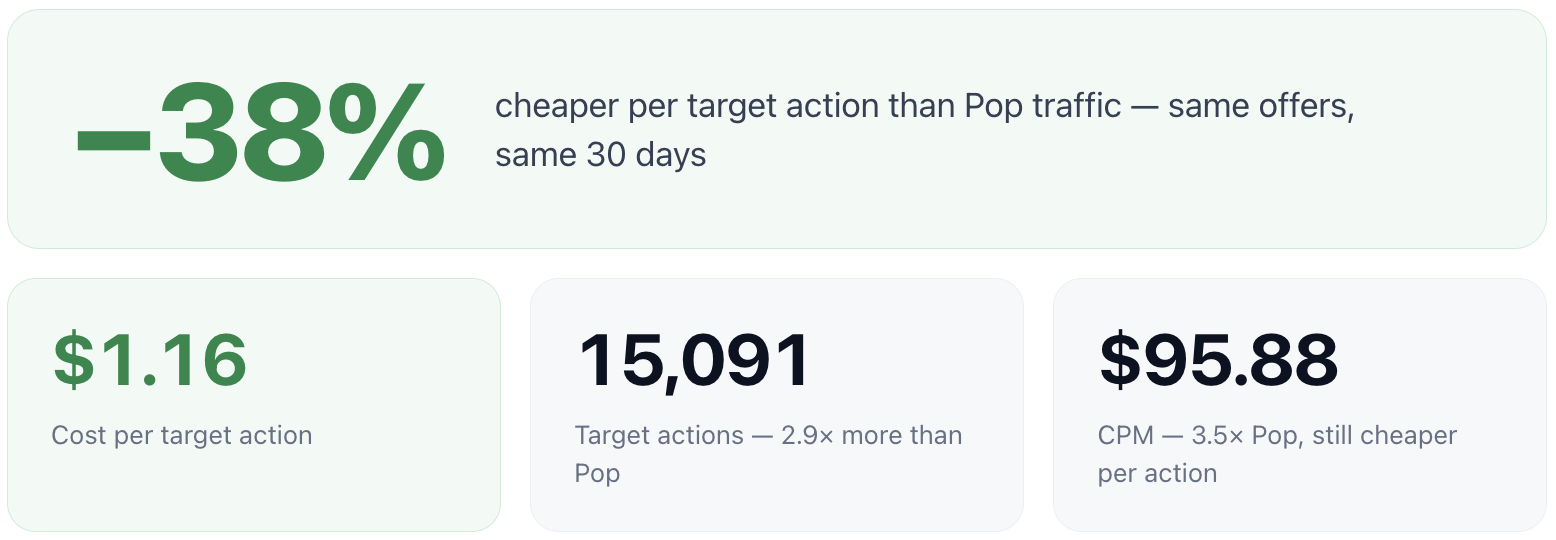
We’re continuing our Paid Social Traffic series with another case where the format cost 3.5× more per impression than Popunder — but delivered target actions 38% cheaper and nearly 2.9× more of them.
The offer, platform, and 30-day testing period stayed the same. So what made Paid Social perform differently?
Both Popunder and Paid Social were tested at the same time.
Here’s the setup:
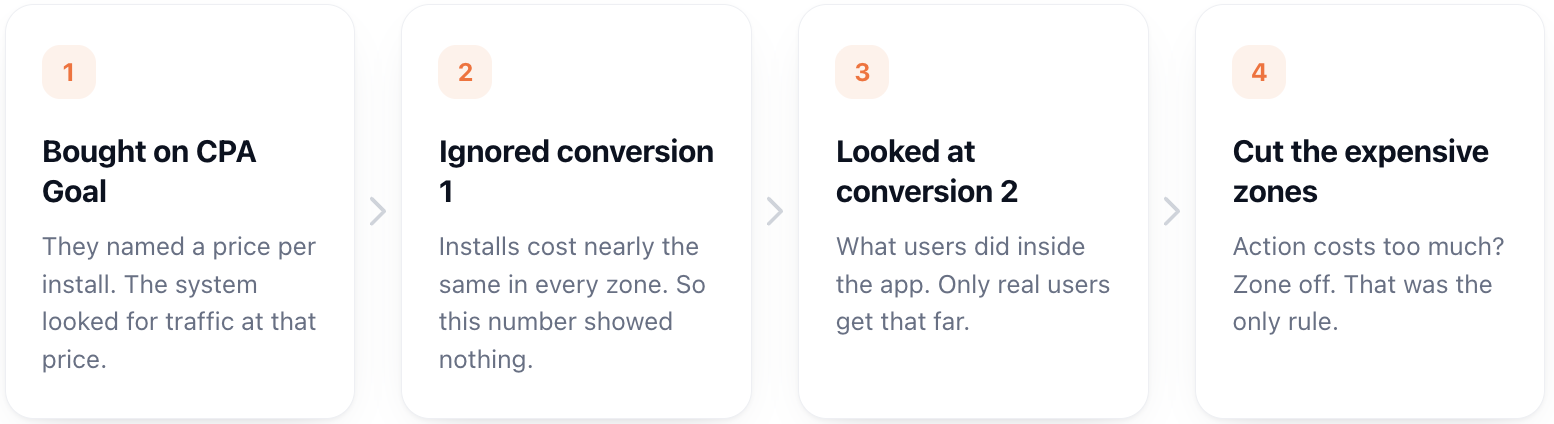
With CPA Goal, you set the price you want to pay for a conversion, and the system delivers at that price. But in this case, the partner wanted to evaluate performance based on the second conversion — the action that happens after the install and indicates that the user is real.
So which format performed better on that deeper event?
Paid Social came out ahead: the target action cost $1.16, compared with $1.87 on Popunder.
At the same time, performance varied across Paid Social zones. Some delivered target actions at the desired price, while others came in significantly higher.
That’s how the winning combination emerged: Paid Social plus the zones that reached the target cost per second conversion.
The spend was distributed toward the strongest-performing zones, giving them the largest share of the budget.
The conversion density then remained stable, with the price per target action holding at $1.16 throughout the full 30 days.
This showed that the selected zones were consistently converting rather than producing a few isolated results that disappeared once the volume increased.
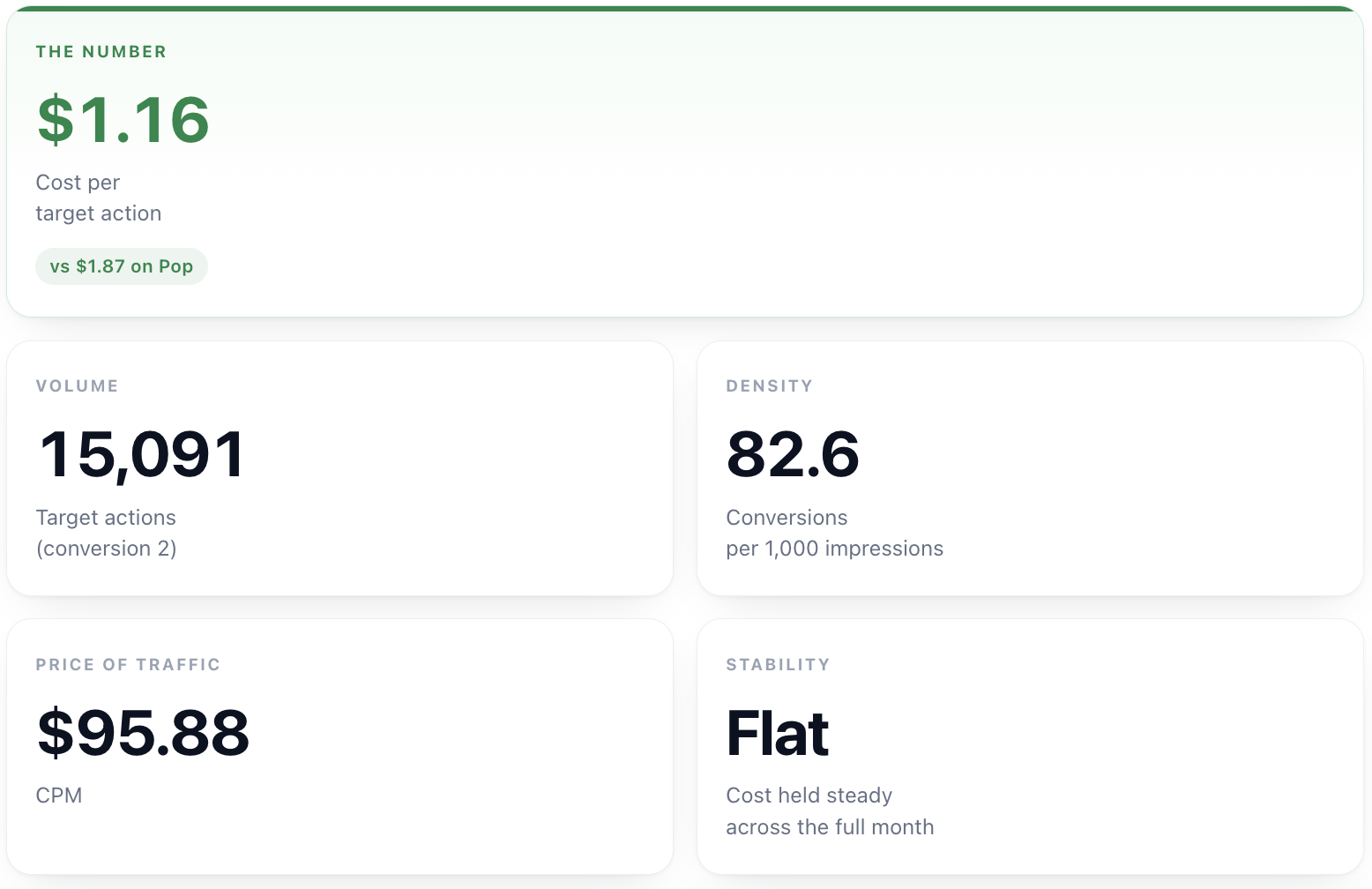
Popunder delivered significantly more impressions for the same amount of money. But it required much more volume to generate a single target action.
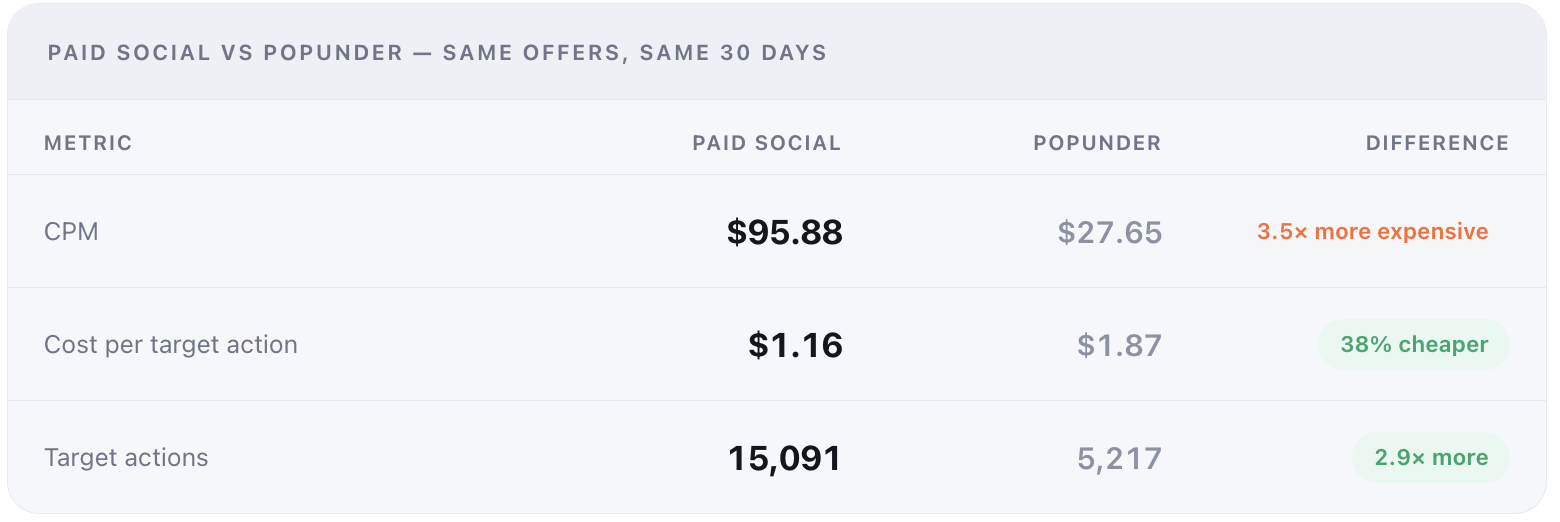
Paid Social was more expensive on impressions, but its conversion density made up for the higher CPM: 38% lower cost per target action and 2.9× more target actions.
Why did this happen?
It comes down to the nature of the format. Paid Social ads appear inside social feeds, where users are already browsing and interacting. The ad becomes part of that activity rather than interrupting it.
The traffic also comes from supply partners with their own custom setups and carefully built user journeys, meaning these users are among the most engaged traffic you can buy.
In this campaign, the target action cost 38% less than with Pop traffic.
The broader pattern is straightforward: you pay a premium for audience quality, and that premium can pay off on offers where the payout depends on deeper events — deposits, installs followed by an action, or registrations that need to be real.
When your payout depends on what users do after the click, CPM alone isn’t the metric to optimize.
Oleksandr Shovkun, Sales Team Leader at PropellerAds: A high CPM on Paid Social isn’t a reason to walk away – it’s simply what a better audience costs, so build it into your bidding strategy from the start. Just don’t judge this traffic by the conversion you set as the goal: the system aims for the same price everywhere, so all the zones look alike. Set up a second event, compare zones by that, and cut the ones where it costs too much. On offers that pay for something simple – a click or an easy lead – the higher CPM has nothing to earn back.
If your offer pays for something deeper than a click — a deposit, a real registration, or an install that leads to another action — the higher CPM can be evaluated against the cost of that deeper conversion.
Launch your campaign NOW!
We’re continuing our Paid Social Traffic series with another case where the format cost 3.5× more per impression than Popunder — but delivered target actions 38% cheaper and nearly 2.9× more of them.
The offer, platform, and 30-day testing period stayed the same. So what made Paid Social perform differently?
The Campaign Settings and Flow
Our partner ran a CPA iGaming offer with a PWA funnel: preland → PWA install → target action inside the app. The campaign used CPA Goal, with the install set as the conversion goal.Both Popunder and Paid Social were tested at the same time.
Here’s the setup:
- Offer type: CPA, iGaming
- Pricing: CPA Goal
- Format: Paid Social, Popunder
- Funnel: PWA – prelander, then PWA install, then iGaming product
- GEO: mix
- Device: mobile, Android
- Schedule: 24/7
- Spend (on Paid Social): $17,523
- Volume: 183K offer impressions
- Period: 30 days, June 10 – July 9
With CPA Goal, you set the price you want to pay for a conversion, and the system delivers at that price. But in this case, the partner wanted to evaluate performance based on the second conversion — the action that happens after the install and indicates that the user is real.
So which format performed better on that deeper event?
Paid Social came out ahead: the target action cost $1.16, compared with $1.87 on Popunder.
At the same time, performance varied across Paid Social zones. Some delivered target actions at the desired price, while others came in significantly higher.
That’s how the winning combination emerged: Paid Social plus the zones that reached the target cost per second conversion.
Zone Optimization and Scaling
Once the strongest combination was identified, the partner increased the budget within Paid Social rather than moving on to other traffic types.The spend was distributed toward the strongest-performing zones, giving them the largest share of the budget.
The conversion density then remained stable, with the price per target action holding at $1.16 throughout the full 30 days.
This showed that the selected zones were consistently converting rather than producing a few isolated results that disappeared once the volume increased.
Results
Popunder delivered significantly more impressions for the same amount of money. But it required much more volume to generate a single target action.
Paid Social was more expensive on impressions, but its conversion density made up for the higher CPM: 38% lower cost per target action and 2.9× more target actions.
Why did this happen?
It comes down to the nature of the format. Paid Social ads appear inside social feeds, where users are already browsing and interacting. The ad becomes part of that activity rather than interrupting it.
The traffic also comes from supply partners with their own custom setups and carefully built user journeys, meaning these users are among the most engaged traffic you can buy.
Main Takeaways
Paid Social can come with a higher CPM while delivering denser conversions.In this campaign, the target action cost 38% less than with Pop traffic.
The broader pattern is straightforward: you pay a premium for audience quality, and that premium can pay off on offers where the payout depends on deeper events — deposits, installs followed by an action, or registrations that need to be real.
When your payout depends on what users do after the click, CPM alone isn’t the metric to optimize.
Oleksandr Shovkun, Sales Team Leader at PropellerAds: A high CPM on Paid Social isn’t a reason to walk away – it’s simply what a better audience costs, so build it into your bidding strategy from the start. Just don’t judge this traffic by the conversion you set as the goal: the system aims for the same price everywhere, so all the zones look alike. Set up a second event, compare zones by that, and cut the ones where it costs too much. On offers that pay for something simple – a click or an easy lead – the higher CPM has nothing to earn back.
To Sum Up
Paid Social isn’t the cheapest option, but it isn’t designed to compete on CPM alone. In this case, its value came from the target action.If your offer pays for something deeper than a click — a deposit, a real registration, or an install that leads to another action — the higher CPM can be evaluated against the cost of that deeper conversion.
Launch your campaign NOW!